Deep sleep is a low-power mode of a microcontroller: the core, the fast clocks and most of the peripherals are switched off, leaving nothing but a residual draw of a few microamps, until a wake-up triggered by a timer or by an outside event. That wake-up is, mechanically, an interrupt.
What is it for?
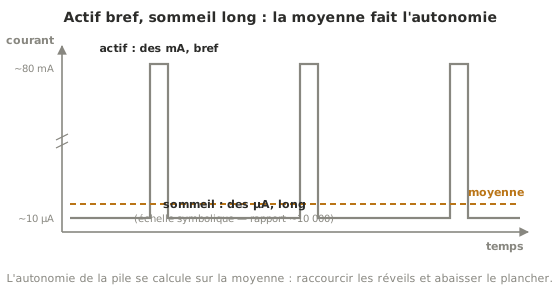
It is the decisive lever for a battery-powered object, and it is an enormous lever, because three orders of magnitude separate the two states: an ESP32 active over Wi-Fi draws 80 to 240 mA, the same one in deep sleep comes down to around 10 µA. A ratio of the order of ten thousand. Alternating brief active phases with long phases of sleep does not “scrape together” a little battery life, then: it moves it into another category, from the order of a day to the order of a year on the same battery (the arithmetic is in the example below).
This is what explains its natural pairing with frugal links such as BLE or LoRa: the object sleeps, wakes to measure and transmit, and goes back to sleep. The object’s current budget is then reckoned on the average consumption, not on the active one (→ concept page Designing a power supply).
How does it work?
Four ideas structure the mechanism.
- A gradation of modes, not a switch. Between “everything on” and “everything off”, microcontrollers offer intermediate steps: light sleep (the core stops but the state is kept, and waking is near-instant), deep sleep (almost everything is cut, consumption in µA), and sometimes an ultimate notch (hibernation) that cuts further still. The deeper the mode, the lower the consumption, and the more the wake-up costs in time and in lost state.
- A small domain stays powered. In deep sleep, not everything is dead: an ultra-frugal island (often called the RTC domain) keeps a slow clock running, along with the wake-up controller and, on some families, a few kilobytes of RTC memory that survive the sleep. It is this night watchman that draws the famous microamps, and it is the one that will switch the rest back on.
- Wake-up sources are armed before going to sleep. Two main families: the timer (the slow clock of the RTC domain comes due — the case of the periodic sensor, cousin of the Timer) and the outside event (a level or an edge on a pin provided for it — button, detector). Some families add touch or coprocessor wake-ups. The wake-up is an interrupt: you configure its source exactly as you arm an interrupt, then you call the sleep function.
- Going to sleep is an explicit act. The program prepares the state to be saved, arms the wake-up source, then calls the sleep function — and execution stops there.
Waking is not resuming — it is (often) a restart
That is the surprise of the first attempt, and it depends on the family. On the ESP32, coming out of deep sleep is a reset: the program starts again from the beginning (the setup function runs afresh), the RAM is lost, and only the data explicitly placed in RTC memory survives. A dedicated function lets you find out why you woke up (timer? pin?). On AVR (the classic Arduino), by contrast, waking resumes execution at the instruction following the sleep call, with the state intact.
The consequence is architectural: a deep-sleep program written “ESP32 style” is not a loop that dozes off now and then, but a cycle of wake up → identify the cause → act → go back to sleep, where the persistent state lives in RTC memory or in storage, a piece of firmware structuring in its own right. Putting it to work: Deep sleep on the ESP32 for the ESP32, Putting an Arduino to sleep for Arduino, Putting a Pico to sleep for MicroPython.
Example — The battery-powered probe
A probe measures and transmits for 2 seconds every 10 minutes (active consumption ~80 mA), and sleeps the rest of the time (~10 µA). Its average consumption comes to:
(80 mA × 2 s + 0.01 mA × 598 s) ÷ 600 s ≈ 0.28 mA
On a 2000 mAh battery: 2000 ÷ 0.28 ≈ 7200 hours, that is about 10 months. The same probe with no sleep would flatten the battery in 2000 ÷ 80 = 25 hours, that is a day. Same cycle, same hardware: sleep alone separates the disposable object from the autonomous one. And the arithmetic shows where to act: shortening the active phase (grouping the transmissions, avoiding a Wi-Fi reconnection at every wake-up) weighs more here than shaving a few µA off the floor.
Pitfalls
Measuring the chip, deploying the board. The ~10 µA are those of the chip. A development board adds a power LED, a linear regulator and a USB interface that all draw current permanently. The real floor climbs back towards the mA, and battery life collapses (with a floor of 1 mA, the probe in the example drops back to ~2 months). Real low power calls for a board designed for it, or for a bare chip.
Forgetting the external peripherals. The microcontroller sleeps, but the sensor, the radio module or the measurement divider wired to the rail carry on drawing current. You have to cut their supply too — a control pin, a transistor — otherwise they are the ones setting the floor.
Believing the program picks up where it was. Depending on the family, waking is a restart (see above): any state not saved to RTC memory is lost, and code written as a plain loop behaves strangely.
Underestimating the cost of waking. Waking is not free: start-up, stabilisation, and above all network reconnection (a Wi-Fi link renegotiates in seconds, at full power). Wake-ups that come too often can consume more than staying awake: space the cycles out and group the transmissions.
Debugging in the dark. During sleep the serial console is silent and the board can look dead. A very short sleep cycle can even get in the way of re-uploading. While developing: trace on waking, keep a long cycle, and provide a way to force the board awake.
See also
- Interrupt — the mechanism behind waking (the source is armed like an interrupt)
- Timer — waking on a deadline, cousin of the timer overflow
- Deep sleep on the ESP32 — putting it to work (RTC memory, wake-up causes)
- Deep sleep on Arduino — the AVR sleep modes in practice
- Deep sleep in MicroPython — the same mechanics for MicroPython
- Power supply — the current budget that sleep transforms
- BLE — a low-power link, the natural complement to deep sleep
- LoRa — remote battery-powered sensors, the same battery-life constraints
- Microcontroller — the chip that offers the sleep modes