Wireless technologies let a system exchange data over radio waves, with no wired link — to talk to a smartphone, to a server, or to other nodes of a sensor network. This page is the entry hub to the protocols most common on a project — Wi-Fi, BLE, Zigbee, XBee modules and LoRa — and gives the method for choosing between them, without detailing each one (that is what the child pages are for).
What is it for?
Wireless frees the system from the cable: it makes an object mobile, allows readings from distant sensors, or connects the project to a phone and to the network. It is often what turns a stand-alone circuit into a connected object.
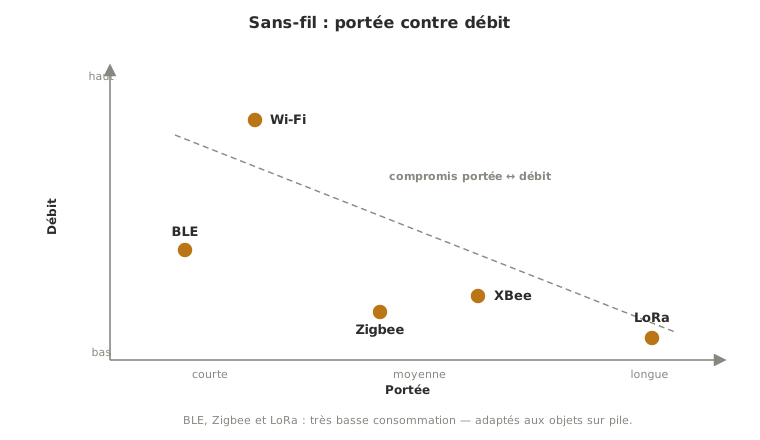
Choosing a technology means weighing up a few parameters, bearing in mind that one fact dominates: range and data rate largely work against each other (the further you aim, the slower you transmit), and that power draw is decisive as soon as an object runs on a battery:
- the useful range (a few metres to several kilometres);
- the data rate you can reach;
- the power draw, and so the battery life — bearing in mind that real battery life is decided as much by the deep sleep between two transmissions as by the radio chosen;
- the topology: star (around a central point) or mesh (each node relays);
- the infrastructure required (access point, gateway) and the frequency band.
This choice comes up during the concept phase and is frozen in the technical design file.
How do you choose?
The five common technologies line up along these parameters:
| Technology | Range | Data rate | Power | Topology | Typical use |
|---|---|---|---|---|---|
| Wi-Fi | local (tens of m) | high | high | star (access point) | internet access, data streams |
| BLE | short (~10 m) | moderate | very low | star (around the phone) | battery sensor, smartphone link |
| Zigbee | medium | low | low | mesh | home automation, sensor networks |
| XBee | medium to long | low | low | point-to-point / mesh | wireless serial link, telemetry |
| LoRa | very long (km) | very low | very low | long-range star | distant sensors, farming, city |
Three pointers about the landscape. XBee is not a protocol but a range of ready-made modules (Digi), which carry Zigbee or proprietary variants inside. The detail lives in the child page. Four of the five technologies live in the same worldwide 2.4 GHz band: they can interfere with one another (and with a microwave oven). LoRa transmits at 868 MHz in Europe: a lower frequency carries further. That is part of the secret of its range.
Three reflexes for settling it. To link the object to the internet or to a smartphone, Wi-Fi (data rate, network access) or BLE (low power, close to the phone). For a sensor network that is large and frugal, Zigbee or the XBee modules, whose mesh extends the range. For a few readings sent from very far away and rarely, LoRa, which trades data rate for distance and battery life.
Putting it to work in practice (protocol stack, antenna, code) depends on the module and the microcontroller chosen: some families carry the radio natively, the ESP32 having both Wi-Fi and BLE on board.
See also
- Wi-Fi — high data rate, access to the local network and to the internet
- BLE — short range, very low power, smartphone link
- Zigbee — low-power mesh for sensor networks
- XBee — ready-made radio modules, wireless serial link
- LoRa — very long range, very low data rate
- Deep sleep — the other half of battery life: sleeping between two transmissions
- Microcontroller — some families carry the radio (ESP32: Wi-Fi and BLE)