The energy chain and the information chain are two sequences of functions that describe any mechatronic system: one says how it acts on the world (the power side), the other how it is driven (the control side). The two are coupled. Information commands energy and measures its effects in return. It is the simplest model for placing every part of a project: power side, or control side.
What is it for?
A mechatronic system does two things at once: it transforms energy to produce an action (turning a motor, heating, moving something) and it processes information to decide what to do (reading a sensor, comparing with a target, commanding). Splitting them into two chains helps you:
- share out the project — the energy chain draws on power electronics and mechanics (our colleagues’ side); the information chain, on sensors, the microcontroller and the code;
- spot the interfaces — it is where the two chains meet that logic levels, drivers and signal compatibility get decided;
- see the control loop — when information measures what energy produced, the loop closes and the system is under closed-loop control.
The model complements the functional block diagram (which shows the functions) and the kinematic diagram (which shows the motions). Here, you follow the flows of energy and information.
The two chains
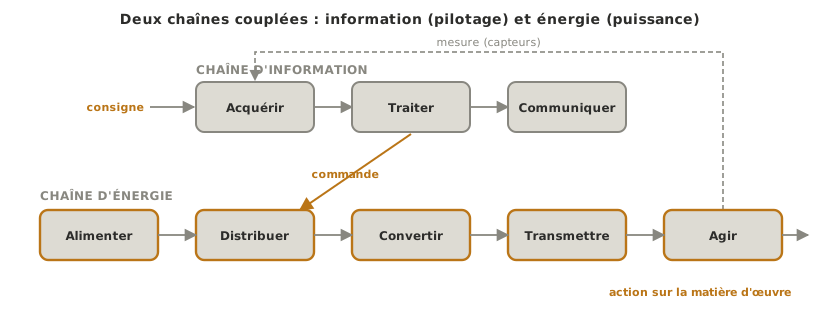
The energy chain transforms a source all the way to the action, in four stages before it acts:
- Supply (alimenter) — provide the energy (battery, mains, regulated supply).
- Distribute (distribuer) — meter it and route it under the control of the command side (driver, H-bridge, relay). This is the driven stage.
- Convert (convertir) — change the form of the energy: a motor converts electrical into mechanical.
- Transmit (transmettre) — adapt the motion (gearbox, belt, gear train).
At the end of the chain, the system acts (agir) on the object it works on.
The information chain drives the system in three stages:
- Acquire (acquérir) — measure quantities (sensors, limit switches, encoders) and take in the target value.
- Process (traiter) — decide: compare with the target, apply a control law (microcontroller, firmware).
- Communicate (communiquer) — report back (display, indicator, network message, feedback to the operator).
The French names are given in brackets because the diagrams of this wiki keep them, and because that is what your teammates will say out loud.
The coupling is what makes the model worth having: the information chain commands the energy chain (typically at the distribute stage) and acquires the measure of its effects in return. This measure → decision → action loop is the heart of a closed-loop system.
Tip
Which parts for each block? Stable families, common in student projects. Check availability, and the datasheet has the final word.
Block Common parts To choose Supply Li-ion battery + BMS, 9-12 V mains adapter, 7805 / AMS1117 / LM2596 regulators Power supply Distribute A4988 / DRV8825 stepper drivers, L298N / DRV8871 H-bridges, relays, MOSFETs Choosing the hardware Convert DC motors, NEMA 17 steppers, SG90 / MG996R servos Choosing the hardware Transmit GT2 belts, gearboxes, gear trains mechanics course (colleagues) Acquire limit switches, incremental encoders, HC-SR04, DHT22, MPU-6050 Choosing the hardware Process Arduino / ESP32 / STM32 families… Microcontroller Communicate SSD1306 OLED, 1602 LCD, LEDs and buzzers, Wi-Fi / BLE Wireless technologies
Example — The 3-axis arm
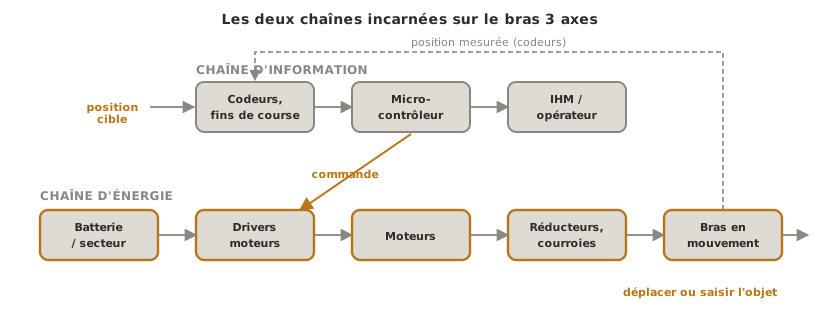
On the arm used as the running example, the two chains read joint by joint. On the energy side: the battery supplies, the drivers distribute power to each axis, the motors convert, the gearboxes and belts transmit, and the arm acts to pick up the object. On the information side: the encoders and limit switches acquire the position, the microcontroller processes it (it compares with the target position and computes the command), and the operator interface communicates the state. The microcontroller commands the drivers and reads back the measured position: the loop is closed, and the arm knows where it is.
Pitfalls
Forgetting the distribute stage. You do not wire a motor straight onto a microcontroller output: you need a driver (or an H-bridge) between the command and the power. Skipping that stage means a burnt output, and it is exactly the stage the chain makes visible.
Mixing up convert and transmit. The motor converts the energy (electrical → mechanical). The gearbox transmits it while adapting it (torque, speed). Two distinct functions, usually in two distinct parts.
Drawing an energy chain with no feedback. With no sensor measuring the effect produced, the system runs open loop: it commands blind. Plenty of failures come from feedback that was never designed in.
Filing a part under the wrong chain. A sensor belongs to the information chain (it reports), even though a current runs through it. The test: does the part carry power (energy) or a quantity you want to know (information)?
See also
- Designing a power supply — the engineering of the supply / distribute blocks
- Functional block diagram — the functions and their flows, a complementary view
- Kinematic diagram — the motions of the mechanism that the energy chain sets going
- Closed-loop control — what the coupling becomes when the measurement comes back to the command: the closed loop
- Microcontroller — the heart of the information chain
- Concept — the phase where these chains are laid down to share out the project