Powering the XIAO ESP32-S3 can be done in three ways — USB-C, a rechargeable LiPo battery, or an external 5 V supply — and the board carries its own charging circuit for the cell. This page explains how to feed it, how to recharge it safely, and above all how long it lasts on battery depending on what it does: it is deep sleep that changes everything.
Three ways to power it
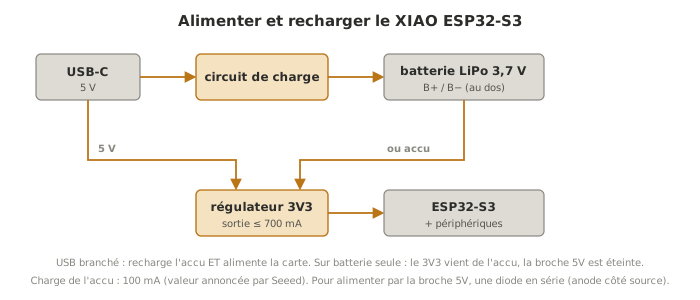
- USB-C (5 V) — the normal case: the board runs and the cell charges at the same time.
- 3.7 V LiPo battery — soldered to the B+ / B− pads on the back, for untethered operation. Careful: on battery alone, the 5V pin is dead (no voltage to draw from it).
- External 5 V — possible on the 5V pin, but through a series diode (a Schottky for preference), anode on the source side, cathode on the 5V side: it prevents current from being pushed back into the USB port.
In every case, the on-board 3V3 regulator provides the board’s logic voltage and can supply up to 700 mA for peripherals. Beyond that, a separate supply is needed.
Recharging the cell safely
The charging circuit is on board: plug in USB-C and it charges. The red LED tells the story: it blinks while charging, goes out once the cell is full (and, with no battery connected, lights up then goes out after about 30 s).
One point matters: the charging current is modest, 100 mA as announced by Seeed. A 400 mAh cell therefore takes on the order of 4 to 5 hours to recharge, the constant-voltage end of charge always dragging on a little. Better a small cell, or some patience.
LiPo battery safety
- Polarity when soldering: the − is on the USB side, the + on the opposite side. Reversing it destroys the board (or worse).
- Use a quality cell with a protection circuit (PCM) against over-discharge and short circuits.
- Never charge unattended or outside the temperature range, and never pierce or crush a LiPo cell: risk of thermal runaway.
How long does it last on battery?
The current drawn depends entirely on what the board is doing. As an example, with a ~400 mAh cell (at 3.8 V):
| What the board is doing | Typical current | Indicative runtime |
|---|---|---|
| Wi-Fi active (transmitting) | ~100 mA | ~4 h |
| BLE active | ~85 mA | ~4 h 30 |
| awake, radio off | ~22 mA | ~18 h |
| light sleep | ~2 mA | ~8 days |
| deep sleep | ~14 µA | ~3 years (theoretical) |
Here is the message: in continuous Wi-Fi, a few hours; in deep sleep between wake-ups, months. The whole art of battery life is to sleep as much as possible and to wake only in bursts (see deep sleep and its ESP32 implementation in deep sleep on the ESP32).
These figures are theoretical (they ignore the cell’s self-discharge, the regulator’s own consumption and ageing): take them as orders of magnitude, not as guarantees. They apply to the bare XIAO: the Sense version sleeps far less deeply (see its page).
Reading the battery level
On the “standard” XIAO ESP32-S3, no pin is wired internally to the battery: all eleven GPIO are already assigned. So there is no way to read the cell voltage in software by default. If needed, wire B+ yourself to a free ADC pad through a divider (to bring 4.2 V below the 3.3 V limit).
See also
- XIAO ESP32-S3 — the board’s hub
- Deep sleep — the number one lever for battery life
- Deep sleep on the ESP32 — the concrete implementation
- Power supply — putting numbers on a current budget
- Logic levels — why 3.3 V sometimes forces an adaptation
- XIAO — getting started — flashing the board