Putting a Pico into sleep (deep sleep) means sending the microcontroller to sleep to cut its consumption, waiting for an event to wake it — a time deadline or an interrupt on a pin. It is the key to battery life: an object that sleeps 99% of the time and only wakes up to act lasts far longer. MicroPython exposes two functions from the [[micropython-modules-en|machine]] module: lightsleep() (picks up where it fell asleep) and deepsleep() (restarts on waking).
What is it for?
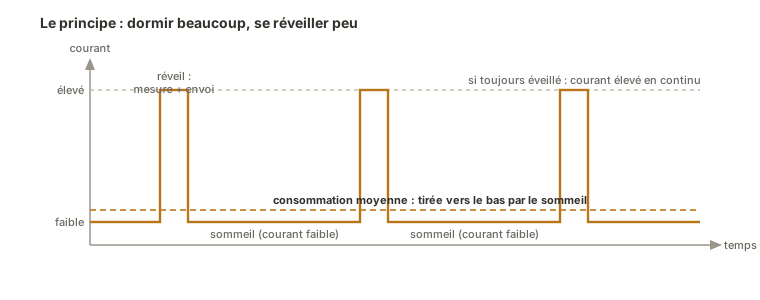
A microcontroller that is awake draws current continuously, even when it is doing nothing useful. For a USB-powered rig that hardly matters. For a sensor on a battery (weather station, beacon, tracker), it is the battery life that collapses. Sleep turns the logic on its head: the system spends most of its time asleep, and only wakes briefly to measure, transmit, then go back to sleep. The cycle: sleep → wake on an event → act fast → go back to sleep.
You put this in place late, during the integration phase, as an energy optimisation of a rig that already works.
lightsleep vs deepsleep — the key difference
machine.lightsleep(ms)— sends the chip to sleep. On waking, the program picks up right after the call, with variables preserved. Consumption is reduced but not minimal.machine.deepsleep(ms)— a deeper sleep. On waking, the chip restarts as though after a reset:main.pystarts again from the top. Variables are lost. You have to save the state (in a file, see persistent storage) before sleeping, and read it back on start-up. It is the same “waking = restarting” behaviour as on the ESP32.
Step by step
Four steps: do the useful work, choose the mode, sleep, handle the wake-up.
1. Periodic wake-up with deepsleep
The most common case: a sensor taking a reading at regular intervals. We measure, then sleep for a given time. On waking, the whole thing starts again.
import machine
from machine import Pin, ADC

# Detecter d'ou vient le demarrage
if machine.reset_cause() == machine.DEEPSLEEP_RESET:
    print("woke up from deep sleep")
else:
    print("normal start-up")

capteur = ADC(Pin(26))
print("reading:", capteur.read_u16())     # reveil utile : on mesure
# ... transmettre, ou sauvegarder dans un fichier (voir micropython-stockage) ...

machine.deepsleep(32000)                   # dort 32 s puis REDEMARRE (main.py relance)
machine.reset_cause() lets you tell a genuine first start-up from a wake-up (machine.DEEPSLEEP_RESET) — useful for running a heavy initialisation only once.
2. Immediate wake-up with lightsleep
If you want to pick up execution without losing the state:
import machine
# ... travail ...
machine.lightsleep(5000)        # dort 5 s, puis REPREND ici (variables conservees)
# ... la suite s'execute normalement ...
3. Waking on an event (a pin)
In principle, to wake on a button or a detector rather than at a fixed deadline, you attach an interrupt to the pin before sleeping. The event then brings the chip back to life (with no duration argument, the sleep lasts until the event):
from machine import Pin
import machine

bouton = Pin(14, Pin.IN, Pin.PULL_UP)
bouton.irq(trigger=Pin.IRQ_FALLING, handler=lambda p: None)   # source de reveil
machine.lightsleep()            # dort jusqu'a l'appui
Waking on a pin: a limitation on the Pico
On RP2 (Pico / Pico 2), waking from
lightsleep()through a pin interrupt is a known limitation of MicroPython: depending on the firmware version, the chip does not wake up (the code above does toggle the interrupt but never resumes execution). The reliable route on the Pico is the timed wake-up (lightsleep(ms)/deepsleep(ms)). For a genuinely well-handled wake-up on an event, the ESP32 is the reference family.
4. Preparing the wake-up (saving state)
Before a deepsleep, since the chip will restart, save whatever has to survive: a cycle counter, the last reading, the state of a machine — in a file on the flash (see persistent storage), read back on start-up. With lightsleep, there is nothing to save (execution picks up again).
Consumption is measured with a multimeter, in series with the rig’s supply:
| Rig state | Current measured |
|---|---|
| Awake, reading under way | … |
lightsleep() | … |
deepsleep() | … |
Do not expect a drop into microamps on the last line: on the RP2040, deepsleep is in practice a lightsleep, and both read the same order of magnitude (see the Pitfalls). That is precisely what the measurement is there to establish, and on top of it comes the permanent consumption of the board’s regulator and USB, which never sleep.
Example — A battery sensor woken periodically
A sensor takes a reading every 60 s, then goes back to sleep with deepsleep. A count of readings survives in a file despite the restart.
import machine, json
from machine import Pin, ADC

FICHIER = "etat.json"
try:
    with open(FICHIER) as f:
        etat = json.load(f)
except OSError:
    etat = {"releves": 0}              # premier demarrage

etat["releves"] += 1
capteur = ADC(Pin(26))
print("reading #", etat["releves"], ":", capteur.read_u16())
# ... transmettre la mesure ...

with open(FICHIER, "w") as f:          # sauver l'etat avant de dormir
    json.dump(etat, f)

machine.deepsleep(60000)               # 60 s de sommeil, puis redemarrage
Between two readings, the chip sleeps. The counter survives thanks to the file, since deepsleep restarts the program. Over time, the ratio of “60 s asleep for a fraction of a second awake” transforms the battery life.
Pitfalls
Believing deepsleep picks up where it stopped. On waking, deepsleep restarts (main.py starts again from zero, variables lost). Save the state in a file before sleeping, read it back on start-up. (lightsleep, for its part, does resume execution.)
On the RP2040, deepsleep saves almost nothing. In MicroPython, the RP2040’s deepsleep is in practice a synonym for lightsleep: it does restart the chip on waking, but it does not come down to the µA of a genuine deep sleep (of the order of a few tens of mA measured). On top of that comes the permanent draw of the board’s regulator and USB. On the Pico, the gain from deepsleep is therefore mainly a teaching point. For serious battery life, aim for a family where deep sleep is properly implemented (the ESP32) or for low-level work (pico-extras). It is an honest divergence from the AVR, where power-down really does reach a few µA on a bare chip.
Falling asleep before finishing a transmission. Communications are asynchronous: make sure the send (Wi-Fi, UART…) is finished before calling deepsleep, otherwise the message is truncated.
A badly configured wake-up pin. Check that the wake-up source (the pin irq) is properly set before sleeping, otherwise the chip sleeps with no way of waking (short of a time deadline).
Forgetting to look at reset_cause(). Without telling a first start-up from a wake-up, every cycle repeats a heavy initialisation (network connection, calibration) needlessly — costly in energy.
Special case — Depth and wake-up sources
lightsleep is simpler (immediate resume, ideal for short pauses between two actions). deepsleep saves more but forces a restart and the saving of state (ideal for long pauses between widely spaced readings). The choice rests on the length of the sleep and on whether the state needs to be kept in RAM. For serious battery life, reason as well about the complete energy budget of the rig (see powering the board).
Where it fits in the project
- Integration and testing phase — energy optimisation comes once the function is validated: measure the consumption, then bring in sleep to reach the battery life you are aiming for.
- Specification — the target battery life (“lasting a season on a battery”) is a requirement to set early. Sleep is the means of meeting it, to be sized against the energy budget.
On a self-contained connected object, sleep is not a detail but the very architecture of the program, which is why it is worth planning for the moment a battery constraint exists.
See also
- Deep sleep — the concept: sleep modes and what they are worth in energy terms
- MicroPython — hub for the module
- Interrupts — the wake-up source for events
- Persistent storage — saving the state before a
deepsleep(which restarts) - Powering the board — energy budget and choice of supply
- Putting an Arduino to sleep — the C++ equivalent (LowPower library)
- Deep sleep on ESP32 — the same “waking = restarting” logic, on a family where sleep is very carefully handled