Non-blocking programming is a way of structuring an embedded program so that the main loop never stops. Instead of waiting with delay(), each task moves forward a little on every pass through loop() and then hands control back: the system can therefore carry out several activities at once and stay responsive. It is not a function to call but an architectural discipline, built on [[arduino-temporisation-en|timing with millis()]] and on state machines.
What is it for?
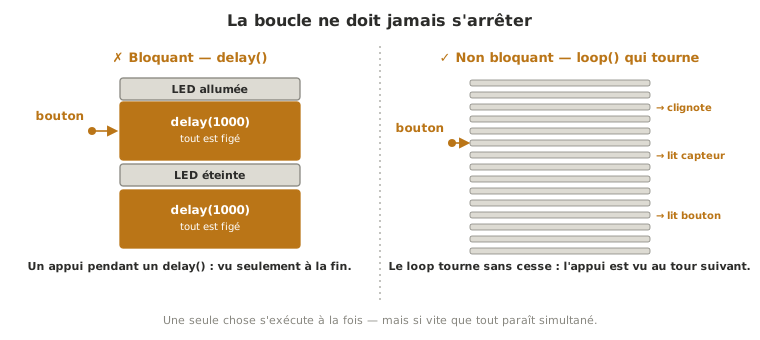
delay() freezes the whole program, not just the task that is waiting: during a delay(500) the board stops reading its button and misses its readings. As long as a sketch does one thing, nobody notices. The moment it does two, you hit the wall.
The design rule that follows fits in one sentence: no function may block, and loop() must always be able to come round again. Why that discipline holds for every embedded program, what it buys you and where it stops, are covered by the cross-cutting concept page non-blocking programming. Here it is put to work in C++ — from the proof of concept onwards, at the first setup that combines several functions.
Step by step
Four steps: state the rule, make each task self-contained, assemble them in loop(), then learn to refactor blocking code.
1. Ban delay(), think in tasks
The mental switch: what the system “does” is cut into tasks, and each task becomes a function called on every pass through loop(), which acts if the moment has come and hands control straight back. No function waits any more. loop() is no longer a sequence of actions but a list of tasks you run through very quickly.
2. Give each task its own time and its own state
A self-contained task carries what it needs:
- time — if it has to fire periodically, it keeps its own
unsigned longvariable and uses themillis() - dernier >= intervallepattern (see [[arduino-temporisation-en|millis()]]); - a state — if it has modes (waiting, running, done), it is a small state machine with its own state variable.
Each task is thus a small independent automaton that knows where it stands without blocking anyone.
3. Assemble the tasks in loop()
loop() does nothing but call each task on every pass. They coexist without getting in each other’s way, because none of them lingers: this is the cooperative loop (or super-loop).
void loop() {
  tacheLED();        // each acts if its moment has come,
  tacheCapteur();    // then hands control straight back
  tacheBouton();
}
The order of the calls barely matters as long as each task stays brief: the loop runs tens of thousands of times per second, so all of them are served almost simultaneously.
4. Refactor blocking code
To turn a delay()-based sketch into a non-blocking one, you deal with each pause in turn. The blocking blinker:
void loop() {
  digitalWrite(LED, HIGH);
  delay(500);                 // <- pause: everything is frozen
  digitalWrite(LED, LOW);
  delay(500);
}
becomes a task that remembers the time instead of waiting:
void tacheLED() {
  if (millis() - tLED >= 500) {     // have we waited long enough?
    tLED = millis();
    etatLED = !etatLED;
    digitalWrite(LED, etatLED);
  }
}
The refactoring rule: every delay() hides an “wait until such a time has elapsed”. You rewrite it as a test on millis(), and every “wait until an event arrives” becomes a test on a condition, checked on every pass.
Example — a station doing three things at once
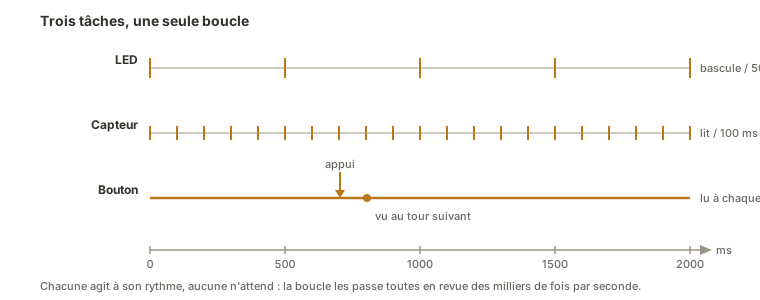
A small measurement station has to, all at the same time: blink a status LED (1 Hz), read a sensor at a steady rate (10 Hz) and react to a button with no delay. Three cooperative tasks, none of them blocking.
const int LED = 13;
const int CAPTEUR = A0;
const int BOUTON = 2;

unsigned long tLED = 0;
const unsigned long INT_LED = 500;        // blink: 500 ms
bool etatLED = false;

unsigned long tCapteur = 0;
const unsigned long INT_CAPTEUR = 100;    // reading: every 100 ms

bool dernierBouton = HIGH;

void tacheLED() {                          // task 1: blink
  if (millis() - tLED >= INT_LED) {
    tLED = millis();
    etatLED = !etatLED;
    digitalWrite(LED, etatLED);
  }
}

void tacheCapteur() {                      // task 2: read at a steady rate
  if (millis() - tCapteur >= INT_CAPTEUR) {
    tCapteur = millis();
    Serial.println(analogRead(CAPTEUR));
  }
}

void tacheBouton() {                       // task 3: react to a press
  // debouncing left out here for clarity — in production, wrap the read as in arduino-entree-tor
  bool lecture = digitalRead(BOUTON);
  if (dernierBouton == HIGH && lecture == LOW) {   // falling edge
    Serial.println("press!");
  }
  dernierBouton = lecture;
}

void setup() {
  pinMode(LED, OUTPUT);
  pinMode(BOUTON, INPUT_PULLUP);
  Serial.begin(115200);
}

void loop() {
  tacheLED();
  tacheCapteur();
  tacheBouton();
}
The three tasks reuse the same millis() pattern as in step 4. The loop() runs continuously and reviews its three tasks on every pass. The LED blinks, the sensor is read ten times a second, and the button is seen the instant it is pressed, because nothing ever stops the loop. Adding a fourth activity (driving a display, listening on the serial port) comes down to writing a fourth task and calling it from loop(): the structure absorbs it without a rewrite. The same thing written with delay() calls would be unworkable.
Special case — a cooperative scheduler
When the periodic tasks multiply, you factor the millis() pattern into a task table rather than repeating the test everywhere: each entry ties together a function, its interval and the date of its last call, and loop() walks the table.
struct Tache { void (*fonction)(); unsigned long intervalle; unsigned long dernier; };

Tache taches[] = {
  { tacheLED,     500, 0 },
  { tacheCapteur, 100, 0 },
};

void loop() {
  unsigned long maintenant = millis();
  for (Tache &t : taches) {
    if (maintenant - t.dernier >= t.intervalle) {
      t.dernier = maintenant;
      t.fonction();
    }
  }
}
How to read this code
The
struct Tachegroups three pieces of information per task: which function to call, at what interval, and when it last ran. Thevoid (*fonction)()field is a function pointer, a slot holding not a number but the address of a function to call (an advanced C++ concept). Thetaches[]array lists every task. Thefor (Tache &t : taches)loop walks them one by one and, for each, notes the date and calls its function if the interval has elapsed. Adding a task then comes down to adding a line to the array: no more tests to copy out.These three mechanisms — the
struct, the function pointer and the range-basedfor— are not specific to embedded work: they turn up in any C++ program, and are picked up as reading cues in reading a program you did not write.
Worth it beyond a handful of tasks. Below that, the direct calls of step 3 stay easier to read.
Special case — the limit: towards an RTOS
The cooperative loop rests on the good behaviour of every task: it guarantees no hard deadline. When a project demands one, you change tools and move to a real-time operating system (RTOS): what it buys you and what it costs are covered by the cross-cutting concept page non-blocking programming.
Pitfalls
A delay() hiding inside a task. A single forgotten delay() in one function is enough to freeze the whole program. The rule holds for every function called from loop(), without exception.
A task that runs too long. Even without a delay(), a task that computes for a long time or waits actively (reading a slow sensor in a loop) blocks the others. In a cooperative design, every task must be brief and, if need be, broken into states (see state machine).
Believing this is real parallelism. It is not: one task runs at a time, very quickly, in sequence. Only interrupts genuinely run “on top of” the loop.
Badly typed time variables. A date from millis() stored in an int overflows within a few tens of seconds: always unsigned long (see the pitfalls in timing).
Waiting for a reply by blocking. Watching for a frame or the end of a movement by busy-waiting freezes the loop. You turn the wait into a test on every pass: “has the reply arrived? if not, I will come back later”.
Sharing variables between tasks carelessly. If one task modifies a variable another reads, think about the order of the calls. And if an interrupt is in the loop, the shared variable has to be volatile.
Where it fits in the project
- Step 3 of the proof-of-concept phase — as soon as the setup does more than one thing (measure and control and signal), structure the code into non-blocking tasks, rather than discovering the blockage at integration.
- Integration and testing phase — the firmware of the complete system is a set of cooperative tasks (or an RTOS): every function validated on its own becomes a task in the overall program.
Adopting the non-blocking discipline at the first multi-function setup saves you the full rewrite that awaits any sketch built on delay() calls, a rewrite that always arrives once the project asks for two things at once.
See also
- delay() vs millis() — the basic tool: non-blocking timing, the building block of every task
- State machine — every task with modes is a small state machine (the generic concept)
- Programming a state machine on Arduino — the same concept implemented along the Arduino path
- Arduino — hub for the Arduino tutorials
- Interrupts — for events the loop cannot catch fast enough
- Hardware timers — to impose a precise rate on a critical task
- Non-blocking programming — the cross-cutting concept: the timing pattern, its twins from one family to the next, and the RTOS boundary
- Reading a program you did not write — the C++ mechanisms of the scheduler above, seen from the reading angle
- Firmware — the architecture of embedded code and the RTOS horizon (cross-cutting)