FreeRTOS is the real-time system at the heart of the ESP32: it lets several tasks run “in parallel”, each written as a small independent loop, which the scheduler interleaves on one or both processors. This is the speciality of the family. The ESP32 has two cores and a native RTOS. The loop() of an Arduino sketch is itself a FreeRTOS task. This page shows how to create and coordinate your own tasks. The why of an RTOS, and its place on the scale of architectures, are covered in firmware.
What is it for?
Multitasking answers a recurring need: doing several things at different rates without tangling them by hand.
Separating activities. Reading a sensor at 10 Hz, refreshing a display at 2 Hz, handling Wi-Fi in the background: each activity becomes a task of its own, instead of a single loop() juggling counters.
Using both cores. A heavy computation task can run on one core while the other handles communication, without either getting in the way.
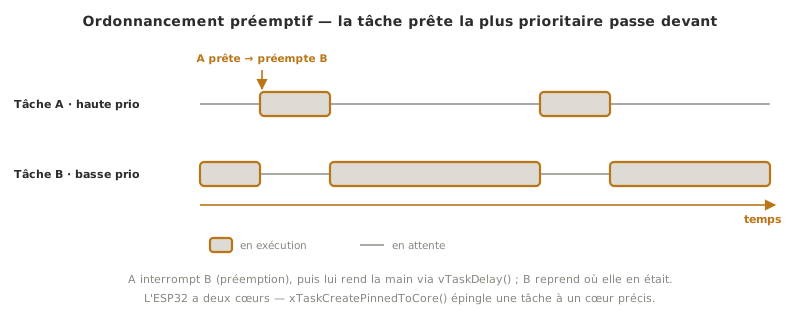
Meeting deadlines. A high-priority task (control loop, safety) goes ahead of the others as soon as it is ready, and preemptive scheduling guarantees its responsiveness.
It is the structured alternative to the cooperative non-blocking loop once the number of activities or the timing constraints grow (see the scale in firmware).
The concepts
Task — a function that never ends (for (;;) { ... }), run as an independent activity.
Preemptive scheduler. It gives the processor to the highest-priority ready task. If a higher-priority task becomes ready, it interrupts (preempts) the running one.
Priority — an integer: the higher it is, the further ahead the task goes.
vTaskDelay() — the FreeRTOS equivalent of delay(), but one that explicitly hands back control: during the wait, the other tasks run. That is what makes coexistence possible.
Two cores. On the original ESP32 you can pin a task to a core (xTaskCreatePinnedToCore) or leave it free.
Creating a task
A task is a void f(void *param) function containing an infinite loop. You launch it with xTaskCreatePinnedToCore:
void blinkTask(void *param) { pinMode(LED_BUILTIN, OUTPUT); for (;;) { // infinite loop: never returns digitalWrite(LED_BUILTIN, !digitalRead(LED_BUILTIN)); vTaskDelay(pdMS_TO_TICKS(500)); // yields the CPU for 500 ms }}void setup() { xTaskCreatePinnedToCore( blinkTask, // task function "Blink", // name (debug) 2048, // stack size in bytes (ESP-IDF) NULL, // parameter passed to the task 1, // priority NULL, // handle (NULL if you do not need one) 1 // core (0 or 1) );}void loop() {} // loop() is itself a task, unused here
Tip
vTaskDelay, not a busy-wait loop. A task that waits with while (millis() - t < d) {} monopolises the CPU and blocks the others. vTaskDelay(pdMS_TO_TICKS(d)) puts the task to sleep and frees the processor: that is the key to coexistence.
Example — Two independent tasks
Two activities at different rates, genuinely separate: one task blinks a LED every 200 ms, the other reads a sensor and prints it every second. No shared counter, no manual interleaving.
Wiring: LED on GPIO16 and sensor on GPIO34 (see the circuits in configuring the GPIO).
const int LED = 16;const int SENSOR = 34; // ADC1void ledTask(void *param) { pinMode(LED, OUTPUT); for (;;) { digitalWrite(LED, !digitalRead(LED)); vTaskDelay(pdMS_TO_TICKS(200)); // 200 ms }}void sensorTask(void *param) { for (;;) { int v = analogRead(SENSOR); Serial.print("Sensor: "); Serial.println(v); vTaskDelay(pdMS_TO_TICKS(1000)); // 1 s }}void setup() { Serial.begin(115200); xTaskCreatePinnedToCore(ledTask, "LED", 2048, NULL, 1, NULL, 1); xTaskCreatePinnedToCore(sensorTask, "Sensor", 2048, NULL, 1, NULL, 1);}void loop() {}
The LED blinks at its own rate, the readings scroll at theirs, without either disturbing the other. Each task is a simple loop, readable on its own. That is the structuring value of the RTOS against a single loop() that would have to juggle two timers.
One line per second on the monitor, while the LED beats five times faster:
The two rates are independent: slowing sensorTask down to 5 seconds would change nothing about the blinking, and the other way round. That decoupling is what a single loop() forces you to build by hand.
Communicating between tasks
Two tasks must not share a variable without precautions (concurrent access means corrupted data). FreeRTOS provides two tools:
Queue. A producer task drops values into it, a consumer task takes them out, in order. This is the recommended channel for passing data.
Mutex (semaphore) — a “token” a task takes before touching a shared resource and gives back afterwards, guaranteeing that only one touches it at a time.
QueueHandle_t queue;void producer(void *param) { for (;;) { int reading = analogRead(34); xQueueSend(queue, &reading, portMAX_DELAY); // put into the queue vTaskDelay(pdMS_TO_TICKS(500)); }}void consumer(void *param) { int received; for (;;) { if (xQueueReceive(queue, &received, portMAX_DELAY)) { // wait for a value Serial.print("Received: "); Serial.println(received); } }}void setup() { Serial.begin(115200); queue = xQueueCreate(10, sizeof(int)); // 10 integers xTaskCreatePinnedToCore(producer, "Prod", 2048, NULL, 1, NULL, 1); xTaskCreatePinnedToCore(consumer, "Consu", 2048, NULL, 1, NULL, 1);}void loop() {}
Pitfalls
A task that never hands back control. A task loop with no vTaskDelay (and no blocking FreeRTOS wait) starves the other tasks and triggers the task watchdog. Every task must yield the CPU regularly.
An unprotected shared variable. Two tasks writing the same variable without a mutex produce inconsistent values (a race condition). Go through a queue, or protect the access with a mutex.
A stack that is too small. A task overflowing its stack crashes (stack canary or a reboot). Increase the size (the 3rd argument, in bytes) if the task uses buffers or recursion.
Returning from the task function. A task function must never return: with no infinite loop, the task ends and can bring the system down. Always for (;;).
Confusing priority with frequency. A high priority does not make a task run “more often”: it makes it go ahead when it is ready. The rate is set by vTaskDelay.
delay() versus vTaskDelay(). On the ESP32 Arduino core, delay() also yields the CPU (it calls vTaskDelay), so it remains acceptable inside a task. But using vTaskDelay(pdMS_TO_TICKS(...)) makes the intent explicit in a multitasking context.
volatile is not a protection. The keyword stops the compiler optimising away reads of a variable. It guarantees neither atomicity nor mutual exclusion. Between two tasks, only a queue or a mutex really protects. volatile has its place elsewhere: for a variable shared with an interrupt (see interrupts), where it is necessary, and still not sufficient if the access is not atomic.
Exercises
Exercise 1 — One task per core
Launch two tasks that each print the number of the core they run on, one pinned to core 0, the other to core 1. Check on the serial monitor.
On a single-core variant (C3, C6, H2), pinning to core 1 fails: pass tskNO_AFFINITY instead of the core number.
Answer to exercise 1
The last argument of xTaskCreatePinnedToCore sets the core, and xPortGetCoreID() reads it from inside the task.
The mutex guarantees that only one task modifies counter at a time: the sequence you read is consistent, with no skipped or overwritten values. (A queue would also do, to pass the values without a shared variable.)
Special case — loop() is already a task
On the ESP32 Arduino core you are never “outside the RTOS”: the core creates a loopTask task that runs setup() then loop(). Creating your own tasks only adds activities alongside that one. So you can adopt multitasking gradually: keep loop() for the main job, and move out into tasks the activities that deserve their own rate or their own core. This is the direct application of the last rung on the scale in firmware.
Where it fits in the project
Step 4 of the proof-of-concept phase. As soon as the prototype has to run several activities at different rates (acquisition, communication, HMI), structuring it into tasks removes the tangle of an overloaded loop() and clarifies the behaviour.
Control loops and deadlines. A high-priority control task, paced by vTaskDelay, guarantees a regular control period, isolated from the other processing.
Choosing between a non-blocking loop and an RTOS at the right moment (see firmware) avoids two traps: an unmanageable loop() full of counters, or an RTOS brought in prematurely where a simple cooperative loop would have been enough.
Going further
Firmware — the scale of architectures, from the super-loop to the RTOS: when to take the step (cross-cutting).