Mechatronics is the engineering of systems that make mechanics, electronics and embedded software work together to deliver a function none of those disciplines would achieve on its own. A mechatronic system senses its environment through sensors, decides through a microcontroller, and acts on the physical world through actuators: the sense → decide → act loop is its founding pattern.
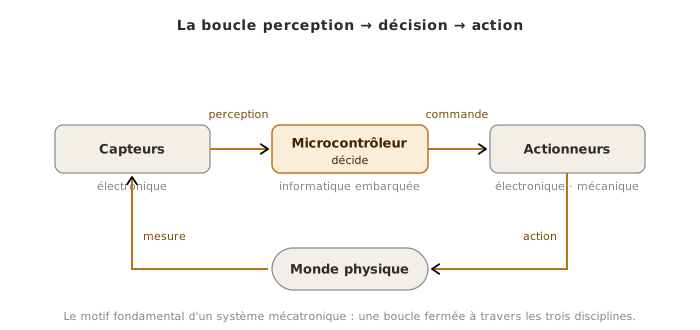
Three disciplines, one system
What characterises mechatronics is not the juxtaposition of the three disciplines but their integration. The mechanical structure drives the choice of actuators. The actuators call for power electronics. The electronics sets the constraints on the firmware. Finally, the software behaviour has to account for mechanical inertia and response times. Designing in a mechatronic way means arbitrating constantly at those boundaries rather than optimising each domain in isolation.
On this wiki, those disciplines are supported by dedicated technical paths, while the project path hub carries the methodology that brings them together: the V-model, from technical specification to integration and testing.
Running example
The whole wiki illustrates these principles on a single project: a 3-axis teaching robot arm. Three motorised joints (mechanics), their drivers and position sensors (electronics), the state machine that orchestrates the movements (embedded software): a minimal but complete system where the three disciplines really do have to agree.
See also
- Project path hub — the V-model methodology
- Microcontroller — the decision-making core of the system
- Technical specification — the starting point of the V-model