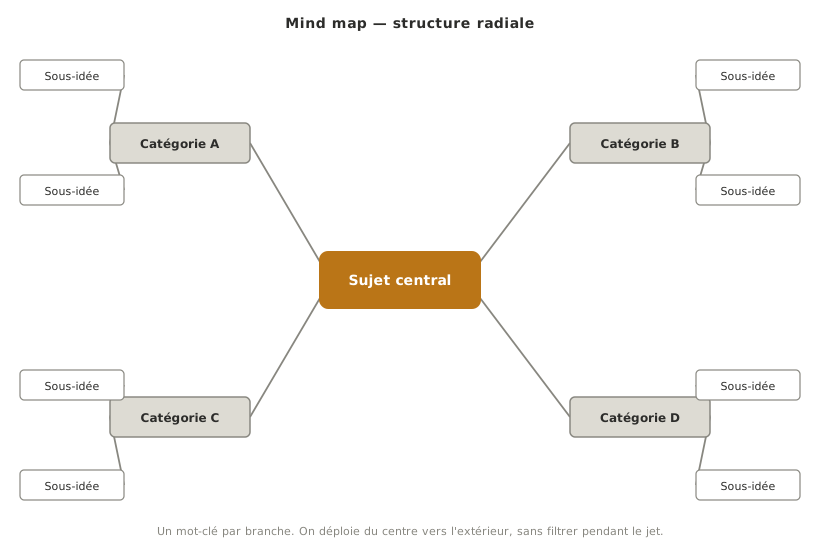
A mind map is a radial diagram that organises ideas around a central concept: you place the subject in the middle of the sheet and unfold branches all around it, ranked by successive associations. On a mechatronics project it serves as a structured brainstorming tool, its most canonical use being to list the surrounding environments of a system before drawing its pieuvre.
What is it for?
A mind map exists to bring out and organise divergent thinking without constraining it too early. Its radial shape follows reasoning by association: one idea calls up another, which you hook on as a sub-branch without having to decide on a linear outline in advance. It is a first-draft tool: you capture widely, you structure afterwards.
On a project it comes in mostly upstream, at three moments:
- Listing the surrounding environments before building the pieuvre: the system at the centre, and all around it whatever surrounds it (users, work object, energy sources, physical environment, regulations). This is the canonical use in technical specification.
- Brainstorming candidate solutions, or exploring a poorly framed problem as a team, before formalising it in a more rigid tool.
- Structuring collective thinking in a kick-off meeting: a shared mind map makes everyone’s ideas and their links visible.
A mind map is not a formal deliverable: it is the scaffolding that comes before a structured tool. A brainstorm of environments becomes a pieuvre. A brainstorm of solutions becomes a decision matrix. Its value lies in what it feeds, not in itself.
How do you build one?
Three moves, in order.
- Put the subject at the centre. The system, the problem or the question, in a central bubble. Everything starts there.
- Unfold the main branches. The broad categories radiate around the centre. For a survey of environments, the branches are the five families (users, work object, energy sources, physical environment, regulations — detailed in the pieuvre page).
- Branch out by association. Each branch subdivides into derived ideas, freely, for as long as they come. You do not filter during the burst: a discreet item noted here is an oversight avoided later.
A few rules make the difference between a useful mind map and a scribble: one keyword per branch (no sentences: brevity forces clarity), no filtering during the burst (you sort afterwards, not during), and visual grouping (colours or zones) so it can be read at a glance. As for tools, paper is enough and remains the fastest for a first draft. To share or rework it together, tools such as Excalidraw, XMind or FreeMind will do.
Example — 3-axis teaching arm
Take the 3-axis teaching robot arm again. Before drawing its pieuvre during technical specification, the team lists its surrounding environments with a mind map, going through the five families one by one.
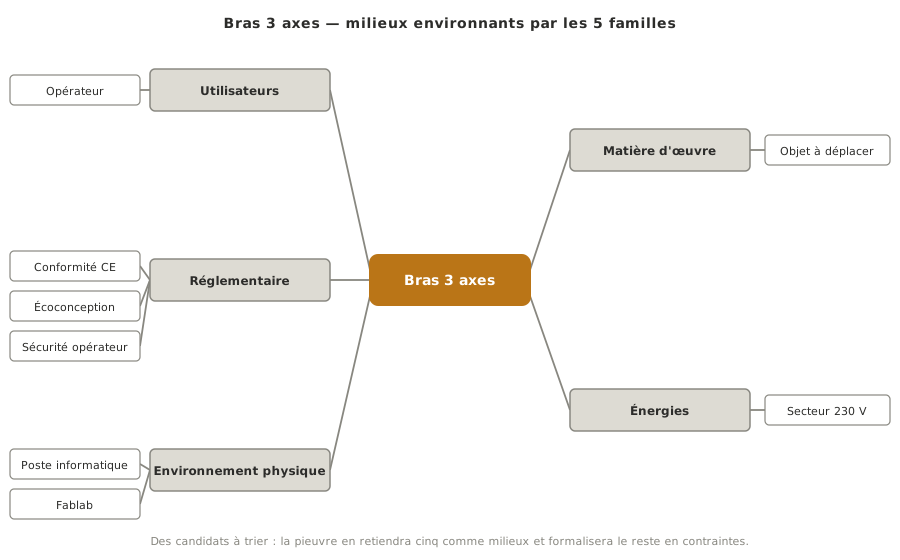
Going through the families systematically brings up eight candidates: the operator (users), the object to be moved (work object), the 230 V mains (energy sources), the computer workstation and the fablab (physical environment and means of manufacture), CE conformity, eco-design and operator safety (regulations). It is by forcing itself through the regulations family, which looked empty at first glance, that the team noted those three constraints, discreet candidates that would have been forgotten in a spontaneous fill-in.
At this stage no function is drawn: the mind map only lists candidates. The sorting happens on the way into the pieuvre: five candidates become the environments of the diagram, where each system ↔ environment link is formalised as an FP / FS / FC function and then numbered. Operator safety becomes the safety FC on the operator environment. Eco-design moves into the criteria of the FCs. CE conformity (noted, traced) is deliberately left out of scope (no certification is aimed at on a school project). This is post-burst sorting in action: the map captures widely, the downstream tool structures.
Pitfalls
Writing sentences instead of keywords. A branch loaded with text kills radial readability and slows the burst down. One or two words per branch: the rewording will come in the downstream tool, not in the mind map.
Filtering during the burst. Judging an idea the moment it arrives kills divergence, and it is often the idea you would have discarded that reveals a forgotten environment or lead. You capture everything, you sort afterwards.
Mistaking the mind map for the deliverable. The mind map is the scaffolding, not the wall. Handing it in as it stands instead of a pieuvre or a decision matrix amounts to presenting a draft as a result. It prepares the formal tool, it does not replace it.
A mind map that leads nowhere. A mind map you draw and then never use downstream is wasted time. Before starting one, know which structured tool it feeds into (pieuvre, matrix, report outline).
Too many levels. Beyond three levels of branching, the map becomes unreadable. If a branch goes too deep, it usually deserves a dedicated mind map of its own.
See also
- Pieuvre — the downstream tool that turns the listed environments into drawn functions
- Technical specification — the phase where the mind map of environments is used (step 3)
- Functional breakdown — another tree representation, but top-down and formal, in the concept phase
- Decision matrix — a downstream tool that a brainstorm of solutions can feed