Programming a state machine in MicroPython means turning a diagram of states and transitions into Python code. Python has neither switch nor enum the way C++ does: we use named constants and an if/elif cascade (or a dictionary of states). One variable holds the current state, and the loop runs the matching block on every pass. Paired with non-blocking timing ([[micropython-temporisation-en|ticks_ms()]]), this pattern drives sequential behaviour — traffic lights, a gate, a machine cycle — without ever freezing the program with sleep().
What is it for?
As soon as a rig has to run through phases (“green, then amber, then red”), two traps are waiting: stacking up sleep() calls that leave the board deaf while it waits, or piling on booleans until nothing can be read. The state machine pattern settles both. It structures the code into one clear block per state, mirroring the diagram. It keeps the loop responsive (between two changes of state, the Pico carries on reading its inputs). It makes the transitions explicit, easy to re-read and to test. It is the skeleton of almost any control program, put in place during the proof of concept.
Step by step
Four steps: list the states, structure the loop, code the timed transitions, wire it up and test.
1. List the states (constants)
There is no enum: we name the states with constants (readable throughout the code), one variable holds the current state, explicitly initialised, and a time variable will stamp the moment we entered that state:
from time import ticks_ms, ticks_diff

VERT, JAUNE, ROUGE = 0, 1, 2     # constantes nommees (pas de enum)

etat = VERT                       # etat initial explicite
t_debut = ticks_ms()              # instant d'entree dans l'etat courant
Named constants rather than bare 0, 1, 2: etat == VERT can be read back, etat == 0 cannot.
2. Structure the loop with if / elif
One block per state. On every pass, only one of them runs — the one for the current state:
while True:
    if etat == VERT:
        # 1) appliquer les sorties de l'etat
        # 2) tester les transitions
        ...
    elif etat == JAUNE:
        ...
    elif etat == ROUGE:
        ...
Two things inside each block: reflect the state on the outputs (light the right LEDs), then test the conditions for leaving towards another state.
3. Code the transitions and the non-blocking timing
A transition is coded in two moves: change etat, then re-stamp the entry with t_debut = ticks_ms(). For a delay there is no sleep(): we compare the time elapsed since entry using ticks_diff:
if etat == VERT:
    if ticks_diff(ticks_ms(), t_debut) >= DUREE_VERT:   # evenement : duree ecoulee
        etat = JAUNE
        t_debut = ticks_ms()                            # on date l'entree dans le nouvel etat
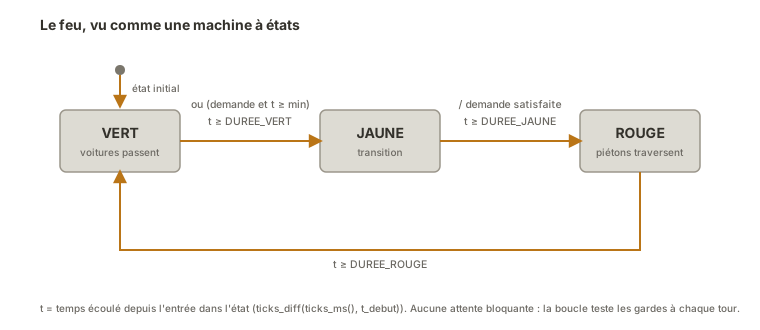
ticks_diff(ticks_ms(), t_debut) gives the time spent in the state. The comparison blocks nothing (see timing). A guard condition from the diagram becomes a combined if: if (duree ecoulee) or (demande_pieton and minimum ecoule).
4. Wire it up and upload
For the example: five LEDs (three for cars, two for pedestrians) with 220 Ω series resistors, and a button between a pin and GND in PULL_UP (see reading a digital input for the debouncing).
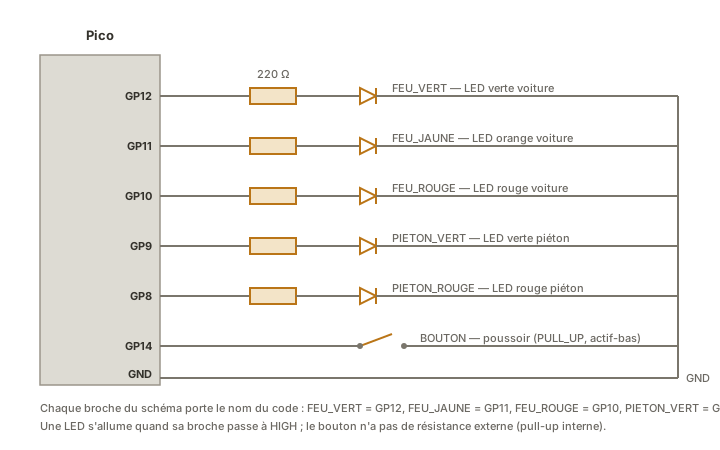
Example — Traffic lights with a pedestrian crossing
Cars follow green → amber → red. Pedestrians have a light and a call button. The button stores a request which, once a minimum of green has elapsed, triggers the change to red — the guard condition [demande and minimum écoulé] from the diagram.
from machine import Pin
from time import ticks_ms, ticks_diff

VERT, JAUNE, ROUGE = 0, 1, 2

feu_vert     = Pin(12, Pin.OUT)
feu_jaune    = Pin(11, Pin.OUT)
feu_rouge    = Pin(10, Pin.OUT)
pieton_vert  = Pin(9, Pin.OUT)
pieton_rouge = Pin(8, Pin.OUT)
bouton       = Pin(14, Pin.IN, Pin.PULL_UP)

DUREE_VERT, DUREE_VERT_MIN, DUREE_JAUNE, DUREE_ROUGE = 6000, 2000, 2000, 5000

etat = VERT
t_debut = ticks_ms()
demande_pieton = False

while True:
    # Evenement : appui pieton, memorise jusqu'a satisfaction
    if bouton.value() == 0:
        demande_pieton = True

    if etat == VERT:                              # voitures passent, pietons stop
        feu_vert.on();  feu_jaune.off(); feu_rouge.off()
        pieton_vert.off(); pieton_rouge.on()
        if (ticks_diff(ticks_ms(), t_debut) >= DUREE_VERT or
                (demande_pieton and ticks_diff(ticks_ms(), t_debut) >= DUREE_VERT_MIN)):
            etat = JAUNE; t_debut = ticks_ms()

    elif etat == JAUNE:                           # transition
        feu_vert.off(); feu_jaune.on()
        if ticks_diff(ticks_ms(), t_debut) >= DUREE_JAUNE:
            etat = ROUGE; t_debut = ticks_ms()
            demande_pieton = False                # la demande est satisfaite

    elif etat == ROUGE:                           # voitures stop, pietons traversent
        feu_jaune.off(); feu_rouge.on()
        pieton_rouge.off(); pieton_vert.on()
        if ticks_diff(ticks_ms(), t_debut) >= DUREE_ROUGE:
            etat = VERT; t_debut = ticks_ms()
How to read this code
The key transition is in the
VERTblock:if ticks_diff(ticks_ms(), t_debut) >= DUREE_VERT or (demande_pieton and ticks_diff(ticks_ms(), t_debut) >= DUREE_VERT_MIN). It reads as “we go to amber if the green has run its full time (DUREE_VERT) or else a pedestrian has called (demande_pieton) and the minimum green has elapsed”. Theoropens two ways out, the second one protected by a minimum so as not to cut short a green that has only just started.demande_pietongoes toTruethe moment the button is pressed (tested at the top of the loop, on every pass) and returns toFalseon enteringROUGE. On every change of state,t_debut = ticks_ms()re-stamps the entry so that the comparisons start again from zero.The precedence of
andoveror, which governs that reading, is a mechanism of the language and not an embedded idiom: see reading a MicroPython program.
The program contains no sleep() at all: the loop runs continuously, reads the button on every pass, and moves on when the conditions are met. Adding a fourth state comes down to adding an elif. The structure takes it without a rewrite.
Pitfalls
Using sleep() for timing. During a sleep(5), the Pico is deaf: it no longer reads the button and reacts to nothing. Mistake number one. Timing is always done with ticks_ms()/ticks_diff().
An uninitialised state. A state variable with no starting value begins in an undetermined state. Always etat = VERT: the initial state is a decision, not an accident.
Re-stamping t_debut at the wrong moment. t_debut = ticks_ms() is done only at the moment of the transition, not on every pass. Resetting it on every pass rearms the stopwatch permanently: the delay is never reached and the machine seizes up.
Indentation instead of break. In C++ every case needs a break (otherwise it falls through). In Python, if/elif does not “fall” into the following block, so there is no fall-through risk, but the indentation has to be rigorous: a badly indented line drops out of the state block.
Testing the input without debouncing. A button read raw may register several presses. Here the storing (demande_pieton = True) absorbs the problem. To count presses or detect edges, debouncing becomes necessary.
An overloaded state block. If a block runs past ten lines or so, some sub-logic deserves a function of its own, or a state ought to be split. Keep every block readable at a glance.
Special case — A dictionary of states, and parallel machines
- The pythonic form: replace the
if/elifcascade with a dictionary mapping each state to the function to run (etats = {VERT: faire_vert, JAUNE: faire_jaune, ...}thenetats[etat]()). More elegant when the states multiply. Theif/elifcascade stays more readable for a handful of states. - Parallel machines: one rig can run several state machines at the same time (a traffic light and a blinking display), each with its own state variable and its own
t_debut, all of them gone through inside the same loop — precisely because none of them usessleep().
Where it fits in the project
- Step 2 of the proof-of-concept phase — first coding of the sequential behaviour of a function (a cycle, an operating mode) on an isolated bench.
- Step 3 of the integration and testing phase — the control logic, validated function by function, is what orchestrates the complete system.
Getting this pattern right on a simple case such as traffic lights gives you the reusable skeleton for every sequential control in the project.
See also
- State machine — the parent concept: states, transitions, guards, actions (to be designed before writing code)
- MicroPython — hub for the module
- sleep() vs ticks_ms() — non-blocking timing, the heart of the pattern
- Non-blocking programming — running several state machines side by side in the same loop
- Reading a digital input — a button with debouncing and edge detection
- Driving a digital output — beyond the LED: relays, buzzers
- State machine (Arduino) — the C++ equivalent (
switch/enum)